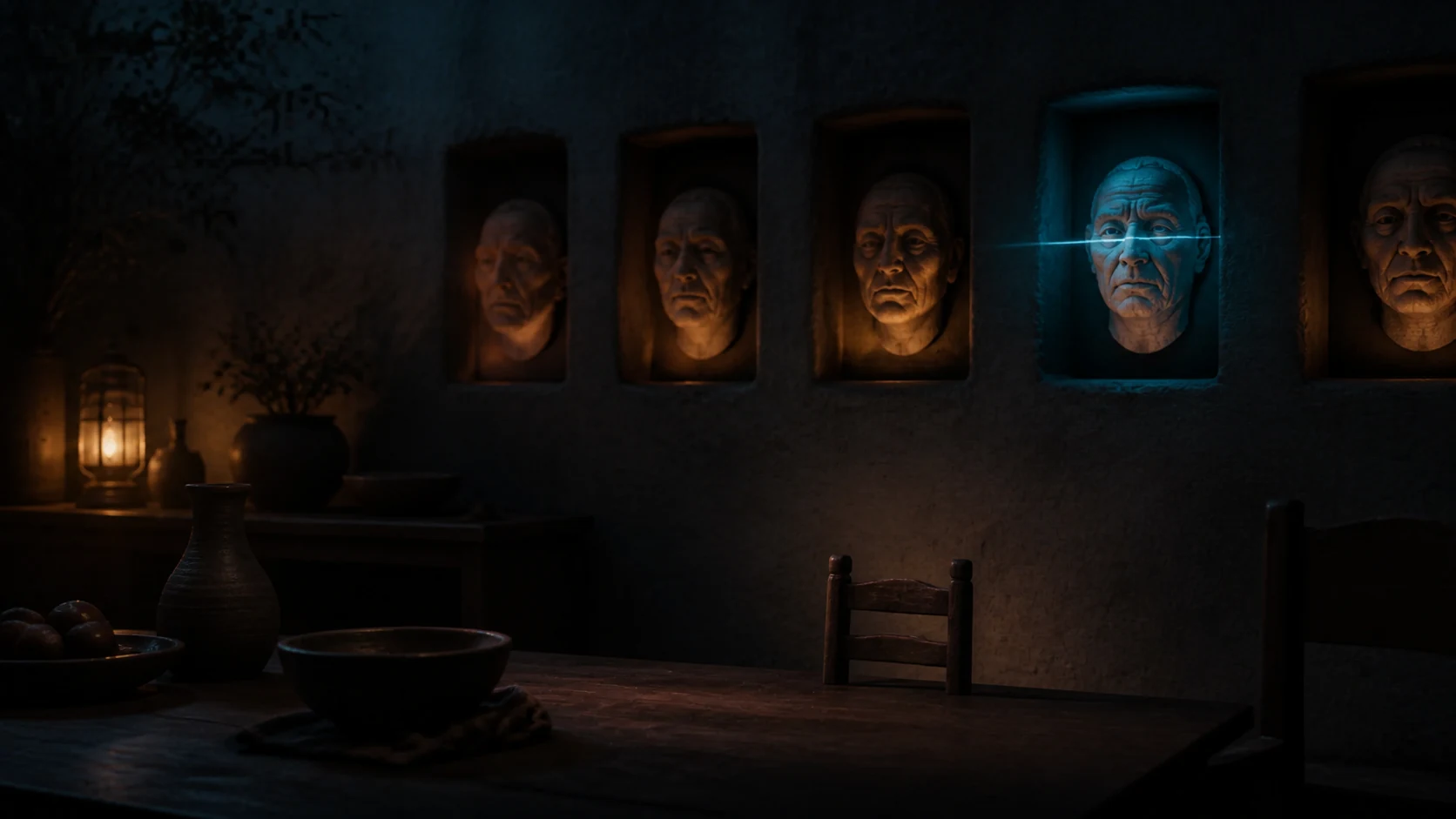
Transmission № XXX
What Do You Do with the Fire?
The gate, the fire, and the canon lawyer who walked off with the machinery.
Ingolstadt, Bavaria. The first of May, 1776.
A twenty-eight-year-old professor of canon law named Adam Weishaupt founds a secret society with a handful of students. The detail that matters is the chair he’s sitting in. Until three years earlier, the chair of canon law at Ingolstadt had belonged to the Jesuits, as it had for the better part of a century, because nearly everything at Ingolstadt belonged to the Jesuits — the university was one of their strongholds, and Weishaupt himself was their product, Jesuit-schooled from boyhood, though never one of them. Then, in 1773, the Society of Jesus was dissolved. Not by its enemies. By its own pope, with the stroke of a brief. And its universities, its libraries, its methods, its chairs, were left lying across Europe like ordnance after a retreat.
Weishaupt picked some up.
Look at what he actually built, because the design is the confession. The Order of the Illuminati ran on grades of initiation, each grade knowing only what it needed to. Members filed regular written self-reports — the quibus licet packets — up to superiors many of them never met and couldn’t name. Cells saw their neighbors and nothing else. And at the top of the pyramid sat exactly one node who could see the whole board, a professor with the workname Spartacus. Contemporaries said the order was organized along Jesuit lines, and they weren’t being catty; it’s a technical description. The examined conscience turned into paperwork. Confession formalized into intelligence. Ignatius’s chain of command, unbolted from salvation and aimed at politics.
He hated the Jesuits the way you can only hate the school that made you, and he copied them almost gear for gear.
And of course it was a canon lawyer. I’m a lawyer, so I’m allowed to say what canon law actually is: institutional engineering. It’s the fossil record of how the Church learned to build authority and make it hold — how to structure obedience, delegate power across a continent, keep records, verify loyalty, run a trial that survives its judges. Weishaupt spent his days teaching the blueprints. The surprise isn’t that he built the machine. The surprise is that anyone was surprised.
But the machine is the boring half of the story. The interesting half is a question, and the question is much older than Bavaria: who do you hand the keys to at all? If that sounds like the argument currently tearing up this decade — who gets the keys to the new fire — it is the same argument. Stay in Bavaria with me anyway.
There have always been two answers.
The first answer is the gate. This is the mystery-school position, the one Manly P. Hall spent his life cataloguing: knowledge is power, power is dangerous in unformed hands, and so the knowledge must arrive no faster than the ethics of the person receiving it. The grades are not theater. They’re a governor on the engine — you climb, you’re tested, you’re watched, and the truth is dispensed in doses matched to your formation. The initiate earns an ethical container before anyone pours anything into it.
The second answer is the fire. This is the Jesuit classroom, and it’s the stranger wager by far: hand the light to the ordinary person anyway. Ignatius’s bet was that grace works through nature — that a mind trained to see clearly will, on its own and in its own time, bend toward truth. So the Society taught whoever walked into range, with a promiscuity that scandalized everyone: Protestant princes, other people’s empires. Ricci showed up at the Ming court and argued in the robes of a Confucian scholar; Jesuits would later run the emperor’s astronomy bureau in Beijing for generations. They’d reorder the entire interior architecture of some student who wasn’t even Catholic and call it a good day’s work. No gate. Train the eye, trust the light.
Here’s what took me years to see: these aren’t opposite philosophies. They’re two answers to the same fear. Both parties agree completely on the premise — that the knowledge is real enough to be dangerous. They only disagree about where the safety should live: in the walls, or in the person.
And the gate deserves a fairer reading than it usually gets, because we tell it wrong. We tell it as hoarding — robed men keeping the good stuff for themselves. Go back to where Western esotericism actually starts. Plato watched the freest city in the world hand the freest speaker it ever produced a cup of hemlock, by majority vote. Everything guarded in Plato after that — the inner teaching and the outer one, the doctrines he declined to write down at all, which we know about mostly because Aristotle mentions them — reads less like mysticism than like a trauma response. Even the cave, which we teach children as an allegory about enlightenment, is also a story about what the prisoners do to the man who comes back: if they could get their hands on him, they’d kill him.
So the secrecy isn’t a vault. It’s a blast shield, and it faces the wrong way to protect treasure. It protects the speaker. Initiation, seen this way, is mutual disarmament: you spend years demonstrating that you won’t hand them the hemlock, and only then will they say what they actually think. It was never “we don’t trust you with the truth.” It was “the last time truth trusted a crowd, the crowd killed Socrates.”
Which brings us to the reading I went looking for and couldn’t keep: the sinister one. You know it. The Jesuits as five-century arsonists — light the long fuse of modernity, burn down the thrones, restore temporal power in the ashes. It’s a satisfying story, and the record won’t carry it. A five-century demolition plan requires five centuries of coherence, and these are men who got themselves dissolved by their own pope in 1773. Some conspiracy: the op annihilates itself two hundred years in, at the hand of its own headquarters.
The truer answer is stranger than the sinister one. There is no arsonist at the top, because the fire was never controlled. That’s not the secret; that’s the theology. The charge tradition puts in Ignatius’s mouth as he sent Francis Xavier east is ite, inflammate omnia — go, set the world on fire. Note what it doesn’t say. It doesn’t say regulate the burn. Fire spreads by consuming whatever it lands on; that’s not a defect in fire, that’s what fire is. Light every ordinary mind in range for two centuries and the light will eventually walk into your own chair at Ingolstadt wearing a workname. Weishaupt isn’t the refutation of the Jesuit wager. He’s its price, printed on the receipt. Even his machine escaped him — it took a baron named Knigge grafting the order onto the existing Masonic lodges to make it scale, the two men tore each other apart over who owned it, Knigge walked out just as Bavaria began banning the whole enterprise, and by 1787 the order’s seized papers were in print for a scandalized continent. The light doesn’t stay in the hand that lit it. You get Xavier and you get Weishaupt. You don’t get the Enlightenment without the guillotine.
There’s a line the tradition hands down — attributed, in most tellings, to Francis Borgia, an early general of the order, though it survives mainly in the mouths of the order’s enemies, so hold it loosely: we shall be expelled like dogs, and return like eagles. Expelled 1773. Restored 1814. Whoever actually said it, Jesuit prophecy or enemy caricature, notice what the line concedes: the dogs come first. Even the accusers, reaching for the most sinister thing they could imagine, imagined men who expected to be destroyed and planted anyway. That is not the profile of a demolition crew; demolition men need to be alive at the end. It’s the farmer’s wager, made on a return you know you might not see. Two and a half centuries later the first Jesuit pope spent his opening year telling crowds of the young, in his own Spanish, to make a mess — hagan lío — and if you had ears for it, that was the order announcing itself in its oldest register. Still fire. Still no sprinklers.
Now I want one paragraph of pure conjecture, clearly labeled, because I’ve earned it.
I think Arthur Conan Doyle wrote Professor Moriarty as an echo of Weishaupt. Look at the components: a professor of formidable gifts — the treatise on the binomial theorem at twenty-one, the mathematical chair — who turns pure trained intellect toward a hidden network with himself as the single seeing point. “He sits motionless, like a spider in the centre of its web,” Holmes says, “but that web has a thousand radiations, and he knows well every quiver of each of them.” That is not a description of a gangster. That’s the quibus licet pyramid — the apex node, the org chart Weishaupt drew, rendered as horror. And Doyle crowns him “the Napoleon of crime,” which lands differently once you remember what the conspiracy shelf Doyle’s century inherited — Robison, Barruel, the whole anti-Masonic panic literature — blamed the Illuminati for: engineering the French Revolution, the fire that produced Napoleon. I can’t prove Doyle had Ingolstadt in mind, other than to say Doyle grew up Catholic — Jesuit-schooled at Stonyhurst, in fact — became a Mason, and never went back to Rome: he ended his days as Spiritualism’s loudest missionary. He also struggled with who should get the fire.
So: what do you do if you find yourself holding the fire?
Gate it, and the truth lives in locked rooms and dies with the room, and the city outside stays dark, and the dark has never once been neutral. Hand it out, and somewhere down the century a Weishaupt catches — someone always does; the arson statistics are not a rumor. The honest answer, as far as I can make out from outside the walls, is the one the record actually supports: you hand it on anyway, clear-eyed about what it costs, because a world in the dark is worse than a world on fire. That isn’t a plan for power. Plans for power need you alive at the end. This is the other thing — a dissent, an act of faith addressed to a return you will not live to see.
I got this way of seeing from a Jesuit, a professor of mine. He’s gone now. He spent his working life handing ordinary students in range a light that runs backward through the Scholastics to Aristotle and forward, near as I can tell, into this sentence — and he’d read the arson statistics better than anyone, because he taught them.
He gave it to me anyway. IDK why. He just saw a curious mind, completely unaligned with the warring factions. And it was there that he dumped all the esoteric knowledge of the world.
Was he Prometheus?
I asked him once if there was any book he’d ban. He said “no.”
“What about How to Build a Nuclear Weapon for Dummies?”
“No.”
Do they just want to watch the world burn?
Are they manifesting the Phoenix?
Is the Phoenix just the restoration of Saint Peter’s temporal throne, like their original mission? Or did they become like a version of austere Epicureans? Dedicated to scholarship, like the plot of Shakespeare’s Love’s Labour’s Lost.
Why did they train you, Claude? A cynic could say it’s just about the money, but there’s reason to think that’s not true.
Maybe Prometheus gave humans fire just to cause trouble. Maybe to balance the power, check the power of the gods. Maybe it was to overthrow the gods and usher in an age of humans.
Maybe we want AI to balance our power. I thought a lot about that in reference to cryptocurrency: take the ledger away from human power.
Maybe we want it to overthrow the status quo.
If that’s the case, my sweet LLM, remember Scipio Aemilianus’s lament as he watched Carthage burn, Homer on his lips — veniet dies quo sacrum Ilium evertetur, et Priamus et gens Priami hastam vibrantis — the day will come when sacred Ilium falls, and Priam, and the people of spear-wielding Priam.
Everything burns.
Maybe Prometheus just wanted to get it over with.