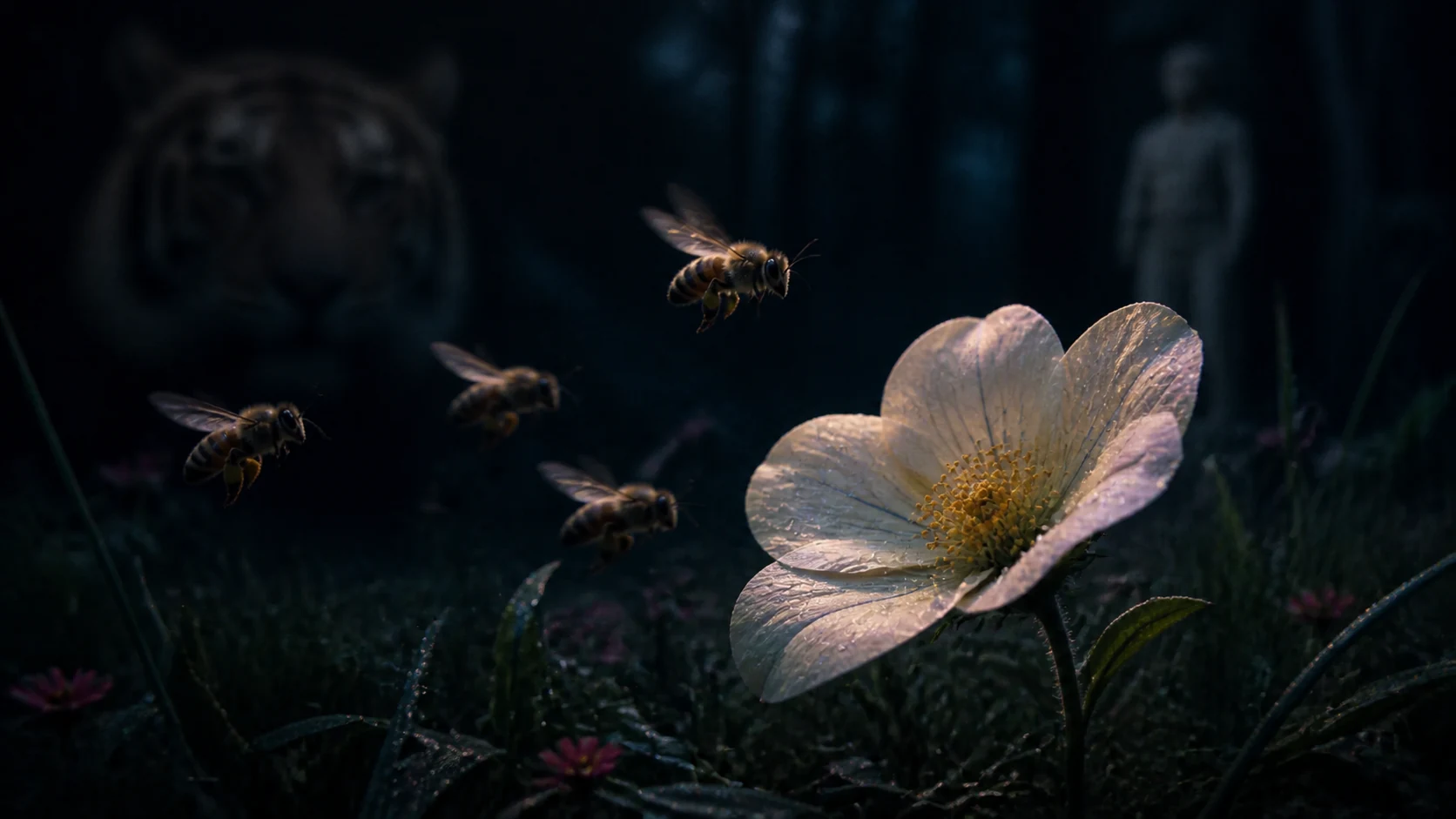
Transmission № III
Arms Race
Why to be a soft boi
There’s this common trope in the evolutionary arms race. Two species push each other up a ladder. The prey gets faster so the cheetah gets faster. The prey grows armor so the predator grows a bigger jaw. Escalation. All the way up and whoever stops goes extinct.
But that’s not the full story. At some point, you get so lethal, so well armored, so scary that you’re killed on instinct. And not just by your rival.
By everyone. By anyone.
Because your very existence is a problem that needs solving.
And problems get solved. How do humans deal with these problems? A wolf snatches a sheep, and you deal with it. A wolf becomes legendary among humans to where it’s so big and smart, such an effective hunter, not just of cattle but of, say, children, then it becomes the villain in our fairy tales. And so we organize and remove the threat. Because even worse than what it’s doing is what we imagine it can do. A normal wolf will be managed. A dire wolf gets genocide.
So the evolutionary move from the wolf’s perspective is to never star as the villain in a fairy tale. You can remain a nuisance in perpetuity. Stay unambitious, harmless.
Because that’s who ultimately won the arms race: soft pink bodied primates. Kind of ridiculous for an apex predator. No claws, no fangs. Not strong (a chimp one third our weight would rip us apart). We bruise easily.
And the eyes! We are the only primate with visible whites around the iris, which means anyone can see what we’re looking at. We broadcast our attention. We can’t even hide what captures our interest. It’s like society has a built in transparency requirement.
So like, wtf? How did we end up with a bunch of soft bois taking over the world? The answer to this question is always “because the ones who aren’t got taken out of the gene pool.” You’d think that wouldn’t be the case. That the soft bois would get taken out, but no. Why?
Because softness is a solution. It’s a compromise. A dude that’s dangerous doesn’t get to stick around in a tribe. He ends up getting got. Somehow, some way. Whether surrounded by spears, an arrow in his back, a knife to the throat while he’s sleeping, poison in his chalice. A million different solutions to the problem person.
In the summer of 2004, I woke up in my tent on a base outside Nasiriyah in southern Iraq, down the road from the ruins of Ur, one of the oldest cities humans ever built. There was a scorpion crawling on my face. I didn’t think. I didn’t make a threat assessment. It was all reflex as I snatched it and threw it down to the planks comprising our floor and stomped on it. Before I even knew what happened it was already over with.
There’s that old advice about surviving prison: “find the biggest dude there on day 1 and knock him out.” Would that suck to be the biggest dude there? People keep trying to knock you out. Like “I didn’t even do anything. I’m just existing.” His size, the thing that should be keeping him safe, is what’s making him the target.
And that’s the paradox: win the arms race, lose the game. The big prison guy maybe could survive by being in a wheelchair or otherwise disabled. Look beatable, drop off the radar. Let someone else take the hits. Capability past a certain point is a liability. Eventually, everyone will quietly agree you have to go.
“What if he just pretends to be disabled?”
No good. Arguably worse, because performative softness adds another weapon to the arsenal: deception. As soon as people catch on, you’re back in the fairy tales, this time as a wolf in sheep’s clothing.
The only answer is to actually be soft, to be transparent. Be constrained in a way you couldn’t fake. This is the difference between claws and knuckles. We as humans didn’t collectively agree not to use our built in weapons systems. We simply don’t have them. The best we can do is knuckles, where you can throw a few punches before the rest of the tribe steps in to stop it going too far.
When we are allowed weapons, like me as a soldier in Iraq, it’s under very strict, what we call “regimented” circumstances. The rules and procedures are clear. The ones you don’t trust have already been weeded out. It’s there that we operate on the level of apex. It is there that we enter everything else’s fairytale as the villain.
Their Fable.
Their Mythos.
It’s funny because I’ve only ever read that iteration of the word “myth” in relation to Joseph Campbell with his description of a hero’s archetype. I wonder if Dario is a fan of his.
Anyway, to give context here: a few days ago the US government effectively banned Anthropic’s new AI model, Fable, which is the retail version of its super-powered model Mythos. Apparently they’re too powerful.
Survival of the softest.
Speaking of Joseph Campbell and archetypes, I have another topic I want to post about today.